
Houlihan Lokey delivered "Project Haven" to 58.com's special committee on June 15, 2020, an update to materials it had first presented three days earlier. Every figure below comes from that presentation.
The short version
58.com, the largest online classifieds platform in China, agreed to go private for $56.00 per ADS, an implied equity value of roughly $8.68 billion. The company wasn't a single business to value, it was a consolidated core platform, a partially-owned used-goods marketplace accounted for as a joint venture, and a scattered portfolio of minority equity stakes in companies most Western readers have never heard of. Houlihan Lokey had to value all three separately, using three different methodologies, before the board ever saw a single number.
Deal snapshot
| Target | 58.com Inc. (NYSE: WUBA) — largest online classifieds platform in China |
| Acquirer group | A consortium including Warburg Pincus, General Atlantic, Ocean Link, and the company’s CEO |
| Target’s financial advisor | Houlihan Lokey |
| Structure | All-cash merger, going-private via ADS cancellation |
| Per-ADS transaction consideration | $56.00 |
| Implied equity value | ~$8.68 billion (RMB ~61.5 billion) |
| Core Business implied enterprise value | ~RMB 24.9B – 27.3B |
| Zhuan Zhuan & ZLJ implied enterprise value (100% basis) | ~RMB 13.0B |
| 58.com’s economic ownership in Zhuan Zhuan & ZLJ | 46.9% / 45.6% |
Why one DCF wasn't going to cut it
Most of the deal breakdowns in this series involve a business you can point to and say "that's the company," a REIT with a property portfolio, a bank with a loan book, a biotech with a drug. 58.com is a different kind of valuation problem entirely, and it's worth understanding why, because it's a real pattern in Chinese internet conglomerates specifically.
58.com had spent years incubating and spinning off adjacent businesses, some it kept full ownership of, some it deconsolidated into joint ventures while retaining a minority stake, and some it invested in as a pure financial investor with no operational control at all. By 2020 the company's balance sheet was, in effect, a holding company balance sheet with a large operating business at the center and a constellation of stakes orbiting it. A single consolidated DCF would either massively overstate the company's value (by treating minority stakes as if 58.com owned 100% of their cash flows) or massively understate it (by ignoring them entirely). Neither is defensible in a fairness opinion, so the deck doesn't attempt either.
The corporate structure: three consolidation levels, three treatments
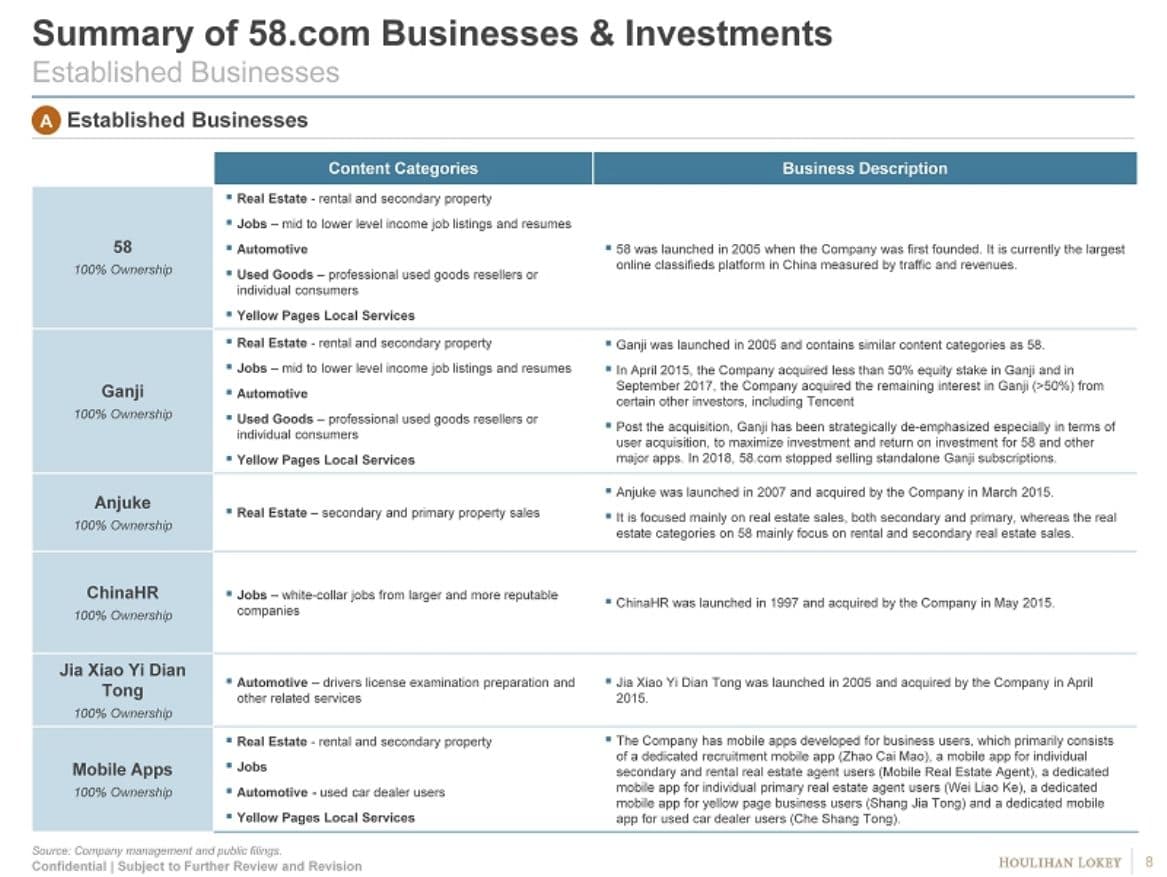
The first bucket is straightforward: 58 itself (the flagship classifieds platform, launched 2005), Ganji (an acquired competitor with the same content categories), Anjuke (secondary and primary real estate sales), ChinaHR (white-collar recruitment), and a handful of smaller mobile-app businesses, all 100% owned and fully consolidated. This is what the deck calls the "Core Business," and it's valued the way you'd value any operating company: trading comps and a DCF.
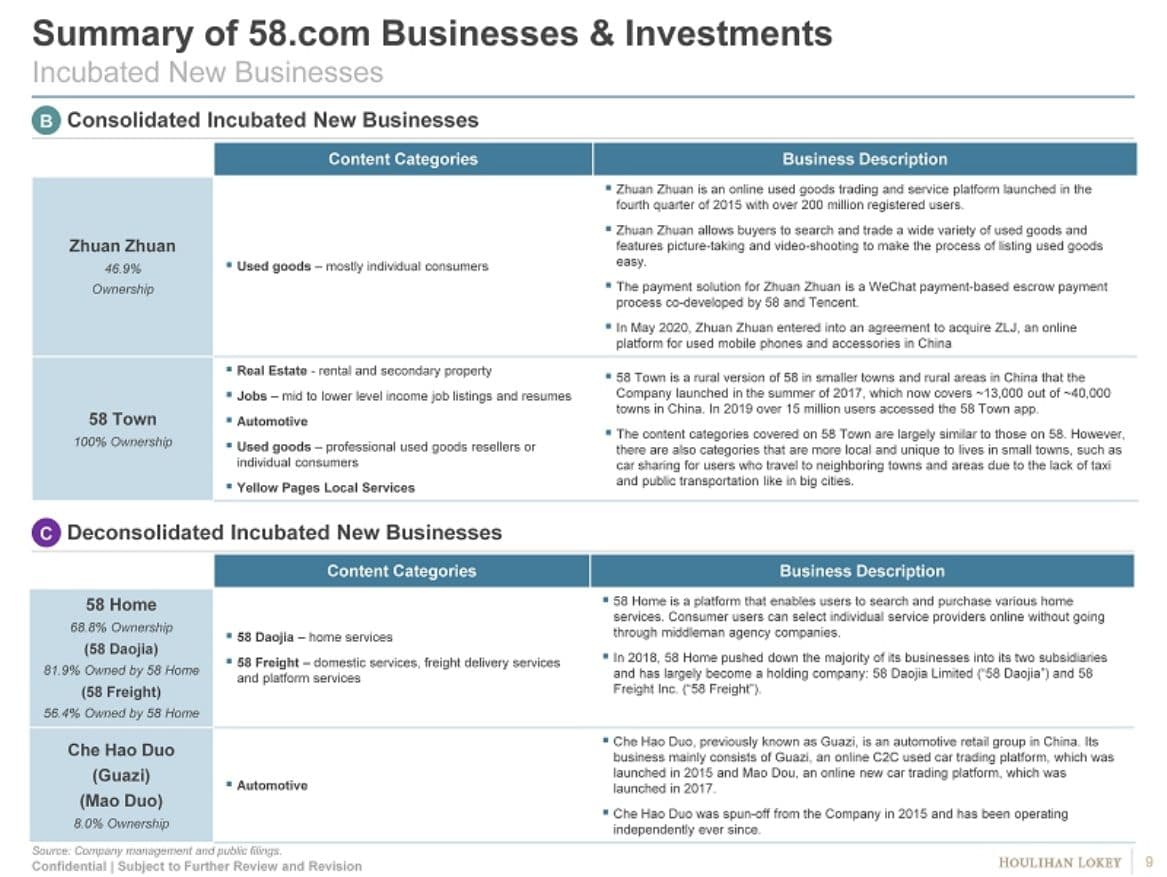
The second bucket is where it gets complicated. Zhuan Zhuan, a used-goods trading platform 58.com launched in 2015, is majority-consolidated at 46.9% economic ownership (structured through a variable-interest-entity arrangement common in Chinese internet companies). In May 2020, mid-negotiation, Zhuan Zhuan agreed to acquire ZLJ, an online used-phone marketplace, which the deck treats as a combined "Zhuan Zhuan & ZLJ" unit. Che Hao Duo, previously known as Guazi, a used-car marketplace, was spun off from 58.com entirely in 2015 and is now held as an 8.0% minority stake with no operational control at all, a pure financial investment.
The practical consequence: Zhuan Zhuan & ZLJ gets its own separate DCF and trading comps, exactly like a standalone company, because 58.com's stake is large enough and structured in a way that warrants full analytical treatment. Che Hao Duo, and a long list of smaller stakes, get valued off recent transaction prices and management's own carrying values instead, because there isn't enough information or control to build a real model.
The core business DCF
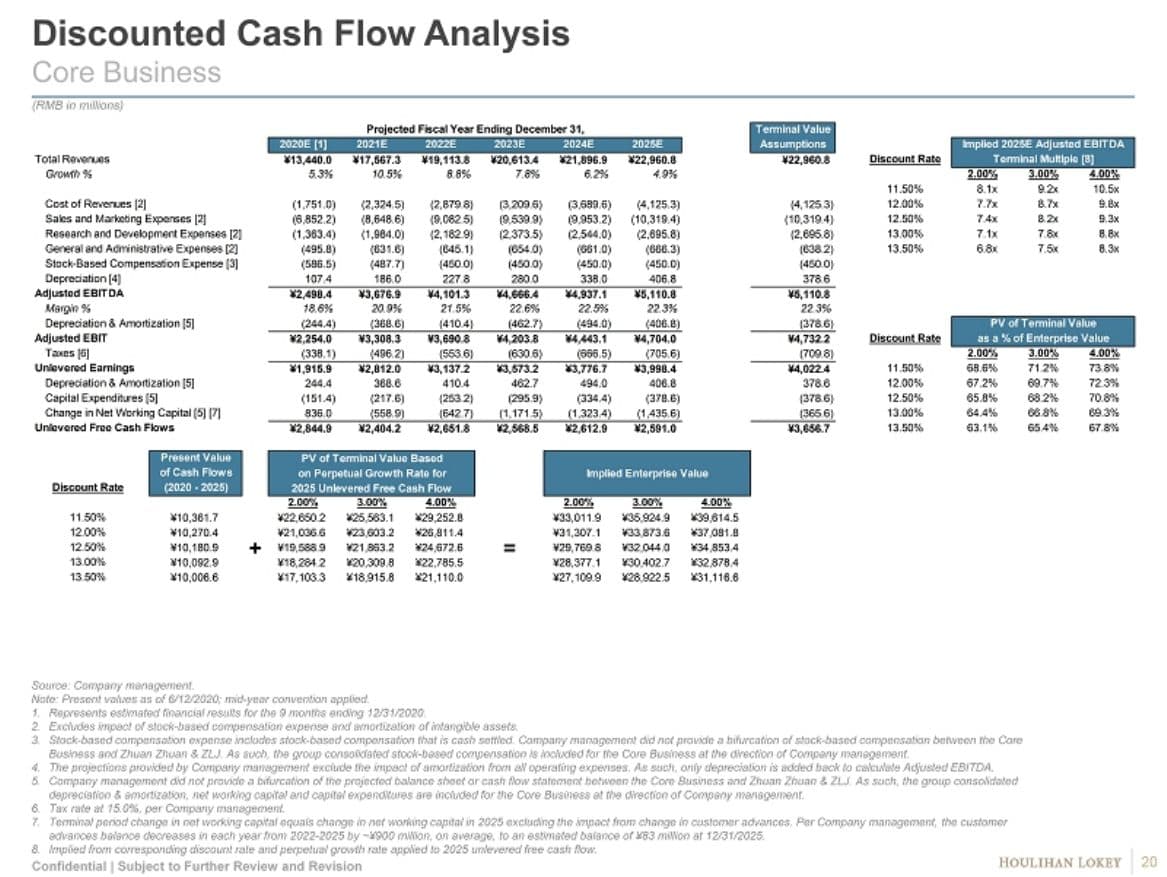
Once you strip out the complexity of everything orbiting it, the Core Business DCF is genuinely unremarkable, and that's the point worth noticing. Revenue projected from RMB 13.4 billion in 2020E to RMB 22.9 billion in 2025E, unlevered free cash flow discounted at 11.5% to 13.5%, terminal value built off a 2.0% to 4.0% perpetuity growth rate, producing an implied enterprise value range of roughly RMB 27.1 billion to RMB 44.4 billion depending on the discount rate and growth assumption chosen. Strip away the Chinese classifieds specifics and this is the same DCF structure used in the Rouse Properties and DryShips breakdowns elsewhere in this series. The complexity in this deal isn't in any single analysis, it's in how many of them had to be built and stitched together.
A second, separate DCF for the JV nobody fully controls
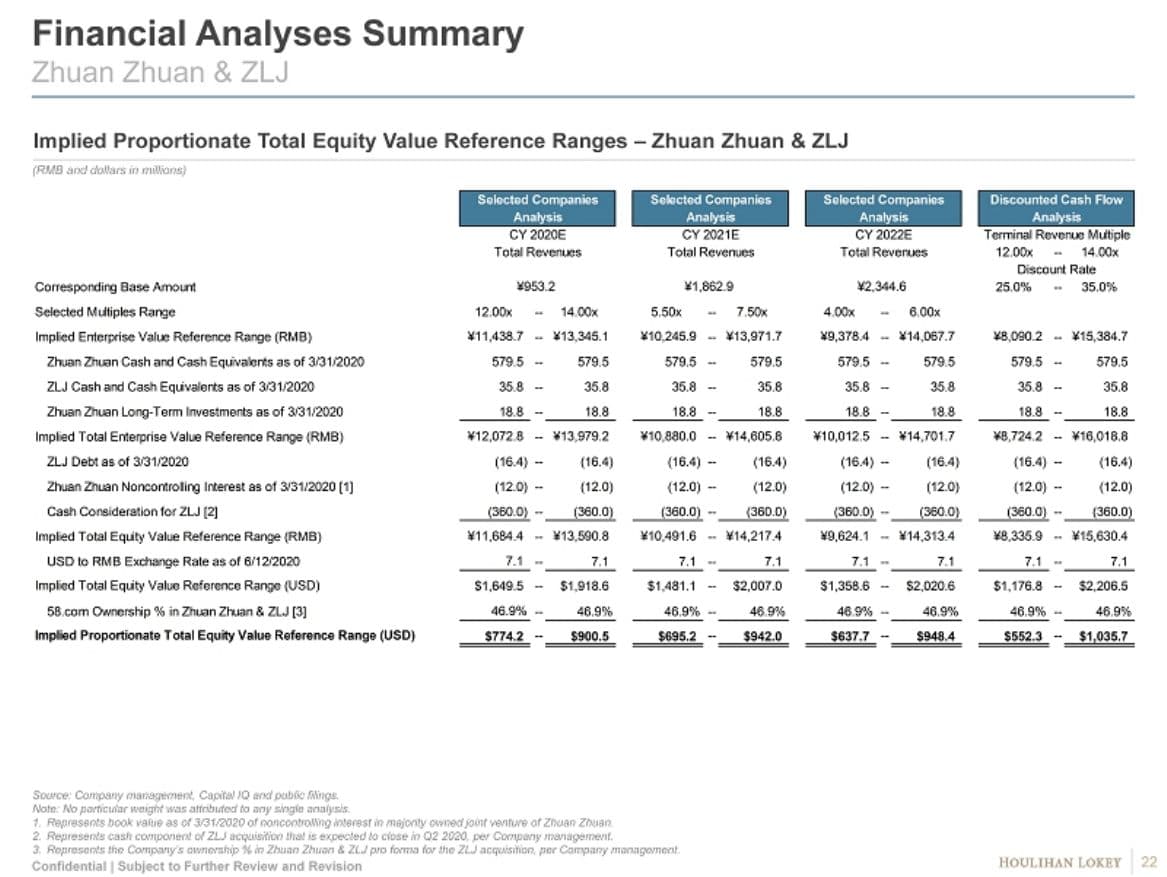
This page is the clearest illustration in the whole deck of what a sum-of-the-parts valuation actually requires. Zhuan Zhuan & ZLJ gets its own trading comps (against revenue multiples, since it isn't profitable) and its own DCF, exactly the way 58 Core Business did, producing an implied total enterprise value range for the joint venture itself. Only after that full standalone valuation is complete does the analysis apply 58.com's actual economic ownership, 46.9% for Zhuan Zhuan and 45.6% for ZLJ, to convert "what is this JV worth" into "what is 58.com's stake in it worth." The final proportionate reference range for this one piece of the puzzle: roughly $552 million to $1.04 billion.
The stub portfolio: valuing what you can't model
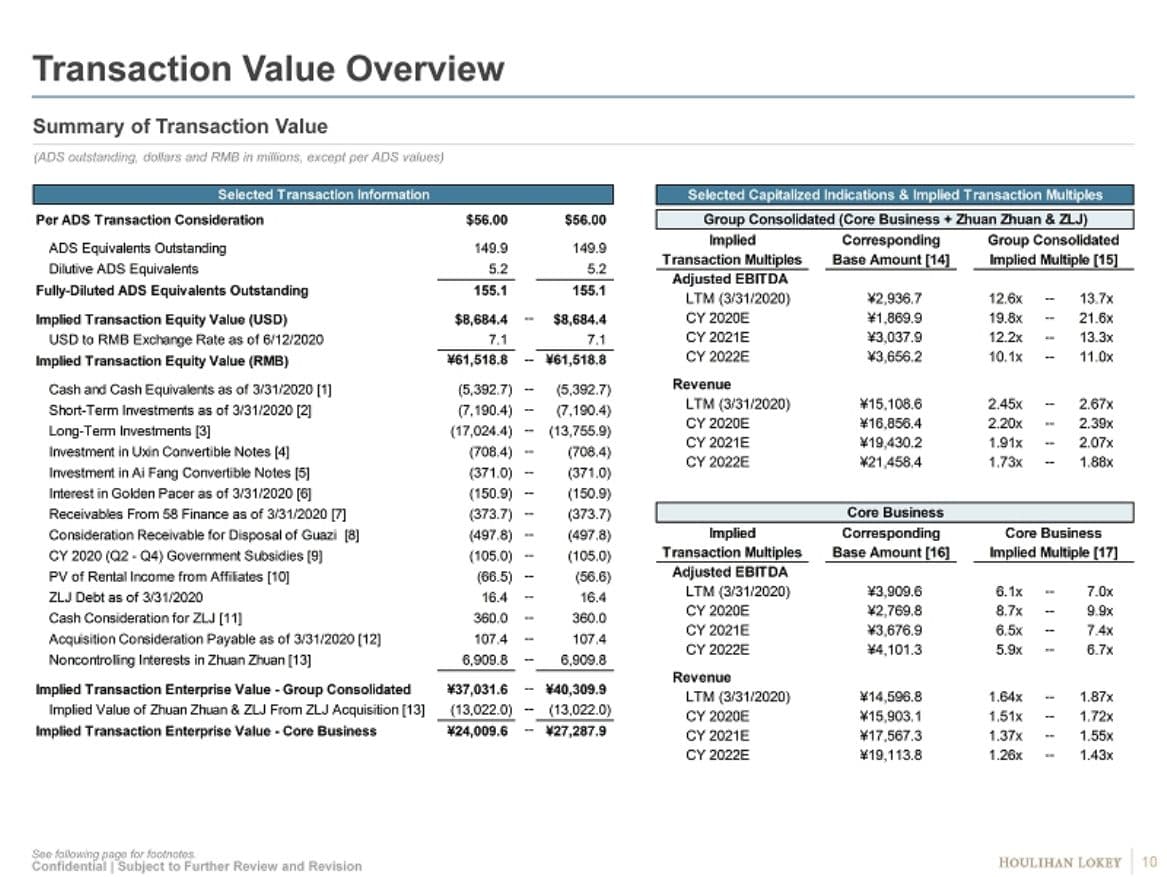
This page is the least glamorous and most instructive in the deck. It walks from the $56.00 per-ADS transaction consideration down to a fully diluted equity value of roughly $8.68 billion, then bridges that equity value to enterprise value through a long list of specific balance sheet line items: cash and cash equivalents, short-term investments, long-term investments (marked at roughly RMB 17.0 billion), an investment in Uxin convertible notes, an investment in Ai Fang convertible notes, an interest in something called "Golden Pacer," a receivable from 58 Finance, a consideration receivable for the disposal of Guazi, government subsidies, and noncontrolling interests in Zhuan Zhuan. None of these is a DCF output. Each is either a book value, a recent transaction price, or a contractual receivable, pulled directly from the company's own balance sheet and management's own schedules.
That's the real lesson buried in this page: a genuinely complete sum-of-the-parts valuation isn't glamorous modeling work end to end, most of it is careful, unglamorous accounting, correctly identifying and sourcing every non-core asset on the balance sheet so the enterprise value bridge actually reconciles.
Assembling the transaction value bridge
Working through the numbers on that page: implied transaction equity value of roughly $8.68 billion (RMB 61.5 billion) bridges to an implied transaction enterprise value, on a group-consolidated basis, of roughly RMB 37.0 billion to RMB 40.3 billion. Strip out the value attributable to Zhuan Zhuan & ZLJ (roughly RMB 13.0 billion), and the implied enterprise value attributable to the Core Business alone falls to roughly RMB 24.9 billion to RMB 27.3 billion, translating to a transaction multiple of 12.6x to 13.7x LTM Adjusted EBITDA for the Core Business specifically.
That distinction, the multiple on the whole group versus the multiple on just the core operating business, matters enormously and is exactly the kind of number a lazier analysis would conflate. Reporting a single blended multiple across a group this structurally complex would understate how richly (or cheaply) any individual piece was actually being valued.
The football field: two businesses, one line
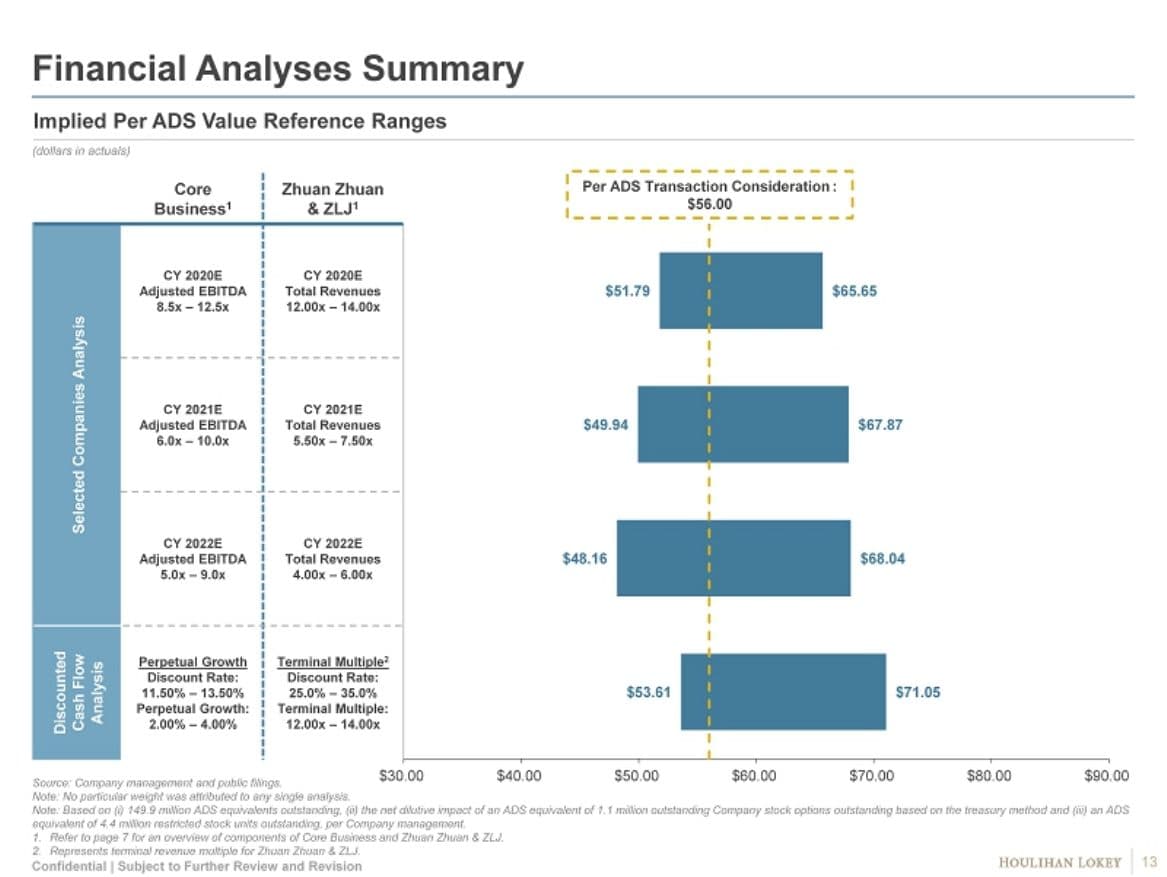
This is the page that finally answers the question a board actually cares about: is $56.00 fair. Both the Core Business analyses (comps by year, DCF) and the Zhuan Zhuan & ZLJ analyses (comps, DCF) are combined into a single implied per-ADS value reference range on one chart, and the $56.00 transaction consideration line runs through every single range shown, from a low of $48.16 (2022E comps) to a high of $71.05 (DCF). Unlike some fairness decks in this series, where the offer sits near the bottom of every range, here $56.00 sits comfortably mid-range across most methodologies, a genuinely defensible outcome rather than a bare-minimum justification.
What a "selected changes" page reveals about a live deal
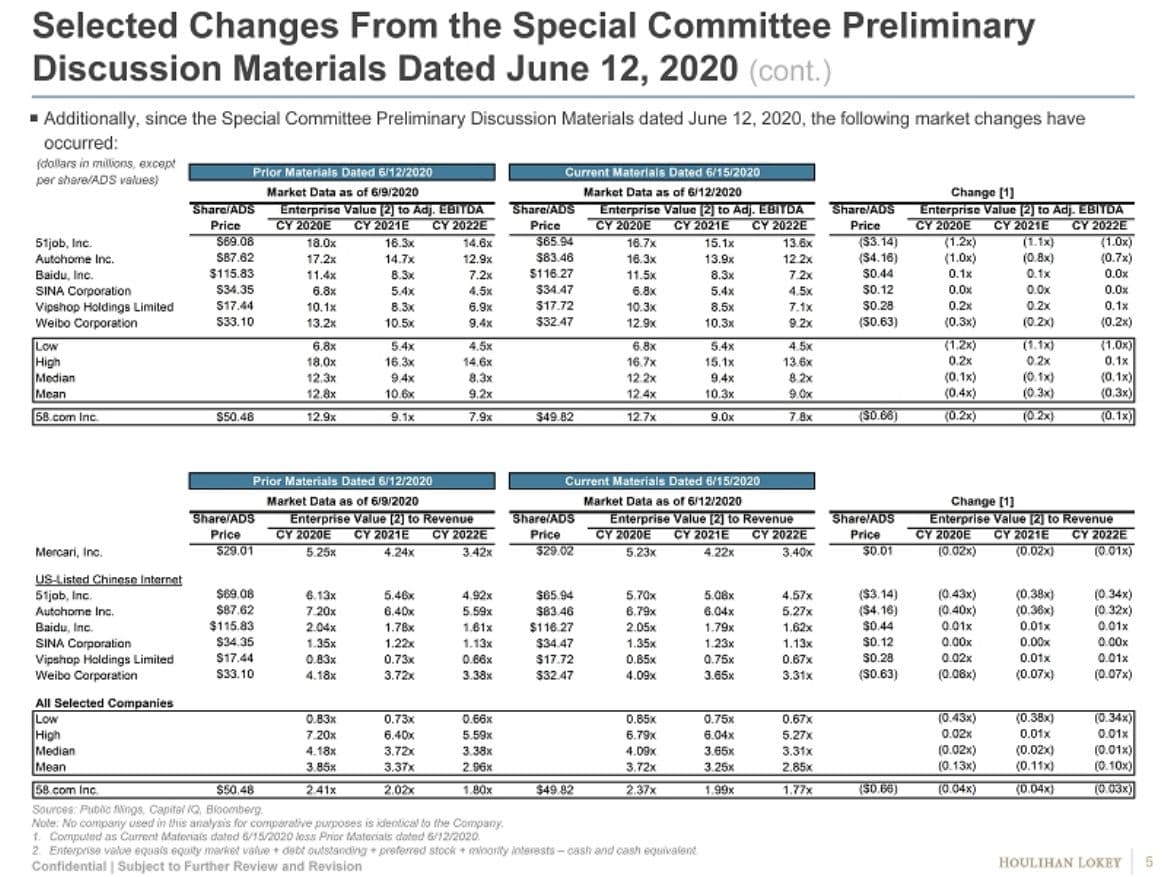
This deck is explicitly a revision, and this page shows exactly why revisions exist: between the June 12, 2020 preliminary materials and the June 15, 2020 current materials, the entire peer comp set, 51job, Autohome, Baidu, SINA Corporation, Vipshop, Weibo, moved, some by more than $4 per share, simply because three trading days had passed. The deck doesn't hide this, it dedicates a full page to disclosing exactly which multiples changed and by how much. That's a small, honest reminder that any fairness analysis is a snapshot, not a fixed truth, and the diligence of updating it (and disclosing that you updated it) is itself part of what makes the process defensible.
What this teaches about valuing a conglomerate
Not every company is one valuation problem. 58.com required at minimum two full standalone valuations (Core Business, Zhuan Zhuan & ZLJ) plus a careful, non-modeled accounting of every other minority stake and receivable on the balance sheet, before a single combined number could be presented to the board.
A joint venture or deconsolidated subsidiary gets valued twice: once as a standalone business (its own comps, its own DCF), and again scaled down to the parent's actual economic ownership percentage. Skipping either step either overstates or meaninglessly ignores the stake.
The unglamorous bridge from equity value to enterprise value, cash, investments, receivables, noncontrolling interests, is frequently where the real diligence work lives in a complex holding structure, not in the DCF itself.
And a comp table has an expiration date measured in days, not months, for a business with genuinely volatile, closely-comparable public peers. A three-day-old comp set moved enough to warrant its own disclosure page here, which is a useful reminder of how fast the ground can shift under a live negotiation.
Every slide and figure in this piece comes from the Houlihan Lokey board presentation delivered to 58.com Inc.'s Special Committee on June 15, 2020, internally titled "Project Haven." This article is for informational purposes only and does not constitute investment, legal, or financial advice.
Keep reading
Want this applied to your situation?
If you're prepping for TMT coverage or M&A technicals, or trying to understand how a sum-of-the-parts valuation actually gets assembled, a session covers your specific situation.