
The controlling shareholder of a public company offers to buy out everyone else. That's the entire genre of "going-private" deals, and DryShips Inc. (NASDAQ: DRYS) is a textbook, if unusually blunt, example of one. Every figure below comes from the Evercore discussion materials filed as an exhibit to DryShips' Schedule 13E-3 with the SEC on September 9, 2019, plus DryShips' subsequent 6-K disclosures. The full deck is public on SEC EDGAR.
The short version
SPII Holdings, a vehicle controlled by DryShips' own Chairman and CEO George Economou, offered to buy out the roughly 16.6% of shares he didn't already control, the "Unaffiliated Shareholders," for $5.25 a share in cash, up from an initial $4.00 offer. Total cost to Economou: roughly $76 million. The deal closed October 11, 2019, and DryShips delisted from Nasdaq.
The interesting part isn't that the deal happened, it's how a Wall Street bank builds the paper trail that lets a board tell a judge, years later if needed, "we did this the right way." That's what this deck is: Evercore's homework, assembled for DryShips' Special Committee.TL;DR
Buyer: SPII Holdings Inc., a vehicle controlled by DryShips' own Chairman & CEO, George Economou. Seller: everyone who isn't Economou, the "Unaffiliated Shareholders," about 16.6% of the company. Price: $5.25/share cash, up from an initial $4.00 offer. Total cost to Economou: roughly $76 million to buy out the public float. Outcome: deal closed October 11, 2019, and DryShips delisted from Nasdaq.
Why a "Special Committee" exists at all
Deck reference: pages 1–2 (Introduction / Overview of SPII Holdings Proposal)
Economou didn't need to buy anyone out to run DryShips, he already controlled it. SPII Holdings and Economou's affiliates owned roughly 83.4% of the outstanding shares. What he wanted was to eliminate the other ~16.6% and take the whole thing private, killing public disclosure obligations, activist scrutiny, and the drag of being a micro-cap Nasdaq name that mostly traded on rumor and repurchase announcements.
The legal problem: when a controlling shareholder buys out the minority, the law (and Nasdaq/SEC going-private rules) demands protection against self-dealing. So the DryShips board formed a Special Committee of independent directors, who hired their own bankers (Evercore) and lawyers (Fried Frank), completely walled off from Economou's side, which had its own counsel (Orrick).
Evercore's mandate, stated bluntly on page 2: opine on whether the cash consideration to the Unaffiliated Shareholders is fair, from a financial point of view. Not whether it's a good deal. Not whether the board should approve it. Just: is $5.25 within a defensible range.
The negotiation, reconstructed from one table
Deck reference: page 6 (Overview of Negotiation Process)
This is the single most useful page in the whole deck if you want to understand deal dynamics in five seconds. It's a price-ping-pong table:
| Date | Party | Price offered |
|---|---|---|
| 6/13/19 | SPII | $4.00 |
| 6/24/19 | SPII | $4.50 |
| 7/3/19 | DRYS Special Committee | (counter) |
| 8/7/19 | SPII | $5.00 |
| 8/18/19 | DRYS Special Committee | $5.25 (final) |
The final $5.25 represented a 66.1% premium to the unaffected price of $3.16 (June 12, 2019, the day before the offer leaked or was announced), a 31.3% increase over Economou's original $4.00 opening bid. That premium number is doing a lot of work in the fairness opinion, 66% over an undisturbed price is the kind of headline number a Special Committee wants sitting at the top of its board presentation.
Who actually gets a vote here
Deck reference: pages 4–5 (Current Organizational Structure / Equity Ownership Summary)
The cap table explains why this needed a fairness opinion in the first place: SPII Holdings / George Economou held 83.4%, everyone else, the Unaffiliated Shareholders, held 16.6%, roughly 14.5 million shares. No single outside institution held more than 0.24%, Invesco was the largest non-Economou holder.
There was no majority-of-the-minority vote condition. That's worth sitting with: even the 16.6% who did have a formal vote weren't guaranteed the deal would fail if most of them voted no, because the merger only required approval of a majority of all outstanding shares, and Economou's 83.4% alone satisfies that. The minority's only real leverage was the Special Committee's ability to walk away or hold out for a better number before signing.
What Evercore actually did (and didn't do)
Deck reference: pages 9–10 (Overview of Evercore Process)
Every fairness opinion deck has a version of this "process" section, and it's mostly boilerplate, but a few caveats here are load-bearing for the rest of the analysis. Evercore relied on management's forecasts without independently verifying them, "at the direction of the Special Committee." That's standard, but it means every DCF number downstream is only as good as DryShips management's projections, the same management effectively controlled by the buyer. Evercore took no independent view on the pending SEC investigation or shareholder lawsuits, those show up later as a cash-flow drag, not a risk-adjusted discount. Evercore explicitly disclaimed any opinion on the reasonableness of the forecasts themselves.
This is normal fairness-opinion hedging language, but it's the tell that the entire valuation exercise sits on top of numbers the target company's own, buyer-controlled, management produced.
The skeletons in the closet
Deck reference: page 8 ("Issues for Consideration")
This is the most candid page in the deck, and arguably the one a retail shareholder should read first. Evercore flags four structural problems baked into DryShips before you even get to valuation.
1. Management agreements
DryShips' ships were run under 10-year agreements with TMS Bulkers, TMS Tankers, and TMS Offshore Services, entities also tied to Economou's orbit, at costs Evercore says ran $0.58–$0.88 per share higher than comparable public dry-bulk peers. Termination would cost $50 million ($0.58/share).
2. Secured debt covenants
These required Economou to keep beneficially owning at least 50% of DryShips' voting stock, meaning the capital structure itself was built assuming his control, another reason a "someone else buys the company instead" outcome was never realistic.
3. Heidmar
The ship-management platform DryShips had bought into had been shopped for sale by Morgan Stanley with no buyer found above what DryShips paid, a soft admission that DryShips overpaid for it, or that the market didn't value it the way DryShips did.
4. Ongoing SEC investigation and shareholder lawsuits
Legal costs were estimated at $500,000–$750,000 per month for 12–18 months, a real, quantified cash drag that gets baked directly into the DCF.
If you're looking for the reason the Special Committee didn't hold out for a much higher number, this page is a good candidate: DryShips wasn't a clean asset. It had a related-party cost structure, a disappointing recent acquisition, and active litigation risk sitting on the balance sheet.
The numbers: trading, cap structure, fleet
Deck reference: pages 11–14 (Public Market Overview & Capitalization / Fleet Summary / EBITDA Breakdown)
Quick facts for the "so what does DryShips actually own" question: fleet of 20 drybulk vessels plus 6 tankers plus 6 offshore support vessels (idled). Net debt of roughly $261 million. Enterprise value at deal price of roughly $993 million. 2019E EBITDA of roughly $75 million (implying roughly 13x EV/EBITDA, rich for the sector, but this includes lossmaking OSV and a modest Heidmar contribution). 2020E EBITDA of roughly $86 million (roughly 9.9x). Drybulk contributed roughly 50–60% of segment EBITDA across the projection window, tankers roughly 25–35%, Heidmar roughly 7–14%, and the OSVs were consistently negative.
The offshore support vessel fleet is basically dead weight in this model, laid up, generating no charter revenue, with operating costs assumed at a flat $400/day just to keep them from rotting.
The valuation methodologies: three ways to get to (roughly) the same number
Deck reference: pages 27–37 (Valuation of the Common Shares)
Evercore ran three standard methodologies, and this is where the "deep dive" actually earns the label.
A. Discounted Cash Flow (DCF)
DryShips and Heidmar were valued separately and then added together, a sum-of-the-parts DCF, which makes sense given how different the two businesses' risk profiles and capital structures are. DryShips standalone: WACC 8.5–9.5%, EBITDA exit multiple 8.0x–10.0x, perpetuity growth 2.0–3.0%, implying a share price range of $3.27–$4.54. Heidmar standalone: cost of equity 10.0–11.0% (materially higher discount rate, a smaller, more people-dependent business), EBITDA exit multiple 5.0x–7.0x, implying a per-share contribution of $0.83–$1.14.
Add them together and the DCF alone lands below the $5.25 offer at the midpoint, call it roughly $4.10–$5.68 combined depending on which end of each range you pick. The deal price sits inside the range but toward the higher end of what a pure discounted cash flow analysis supports.
B. Public market trading analysis
Evercore benchmarked DryShips against six tanker peers (DHT, Euronav, Frontline, INSW, Nordic American Tankers, Teekay Tankers) and six drybulk peers (Diana Shipping, Eagle Bulk, Genco, Golden Ocean, Safe Bulkers, Star Bulk). Tanker peer median EV/EBITDA: 7.3x (2019E) / 4.3x (2020E). Drybulk peer median EV/EBITDA: 9.0x (2019E) / 8.4x (2020E). DryShips itself traded at 7.9x / 6.9x, cheaper than drybulk peers, roughly in line with tankers.
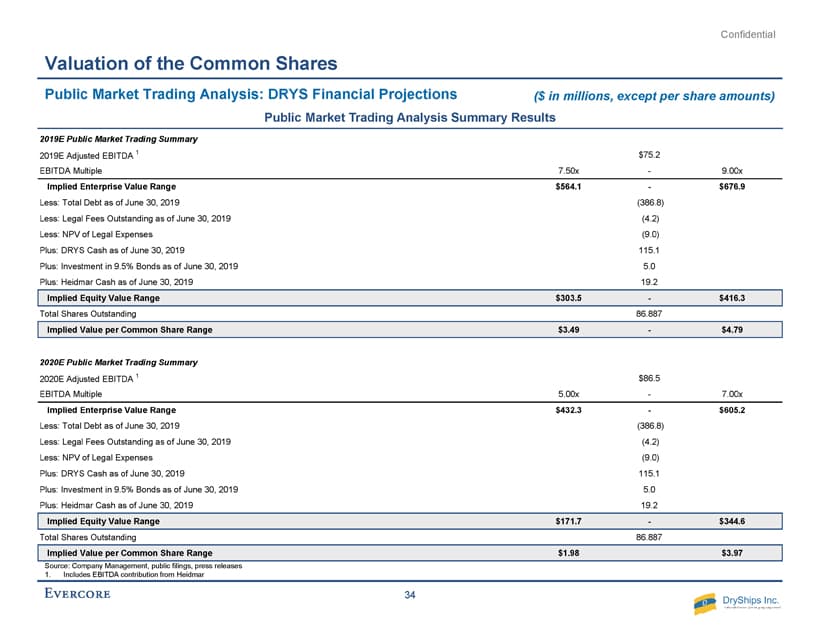
Applying peer multiples to DryShips' own EBITDA produced implied share values of $3.49–$4.79 (2019E) and $1.98–$3.97 (2020E), the 2020E read is notably below the offer price, one of the more shareholder-unfriendly data points in the whole deck if you're the one getting bought out.
C. Net Asset Value (NAV): what are the ships actually worth
This is the sum of third-party broker appraisals (from SSY and Clarksons for drybulk/tankers) minus secured debt, plus cash, minus remaining drydock/scrubber capex, plus Heidmar valued at its actual recent purchase price ($51 million). Total NAV range: $566M–$593M. Per-share NAV: $6.51–$6.83, midpoint $6.67.
This is the important one. Every other methodology values DryShips below its own asset value. The $5.25 offer represents roughly 0.79x adjusted NAV, shareholders were being bought out at a meaningful discount to what Evercore's own appraisers said the physical ships and cash were worth. That's not unusual for shipping, public shipping equities have traded below NAV for years because of cyclicality, corporate governance discounts, and illiquidity, but it's the single number a skeptical shareholder would point to and say "I'm getting less than the boats are worth."
D. Precedent transactions & premiums paid
Comparable shipping M&A averaged roughly 8.1x EV/EBITDA and roughly 0.99x Price/NAV, again, DryShips' 0.79x NAV multiple sits below the precedent average. Broad-market premiums-paid data (288 all-cash going-private-style deals) showed a median 1-day-prior premium of just 13.0%, and 13.8% across the 59 deals in DryShips' own $250-500mm size bracket. DryShips' deal, 66.1% over the unaffected price, blew past that median several times over.
That's the tension the whole deck sits inside: on a premium-to-undisturbed-price basis, this looks generous. On a price-to-asset-value basis, it looks stingy. Both things are true simultaneously, and it's exactly the kind of framing a fairness opinion is built to let a board live with.
Sensitivity cases: Evercore stress-tests its own numbers
Deck reference: pages 25–26, 39–41 (Sensitivity Cases)
At the Special Committee's request, Evercore reran the DCF assuming Newcastlemax (large drybulk vessel) spot rates were 10%, 15%, and 20% higher than management's base case from 2H 2021 onward, essentially testing "what if the dry bulk market recovers better than management assumes."
Result: even in the most bullish +20% rate scenario, the DCF-implied share price tops out around $4.87, still below the $5.25 deal price. That's a meaningful data point in the fairness opinion's favor, Evercore is showing that even under a materially more optimistic freight-rate world, the offer still looks full relative to DCF.
The verdict, visually
Deck reference: page 28 (Common Share Valuation Summary, the football field chart)
Page 28 is the page every banker builds an entire deck around: the "football field" chart stacking every methodology's range side-by-side against the $5.25 offer line.
| Methodology | Implied share price range |
|---|---|
| DCF (exit multiple) | ~$3.27 – $4.54 |
| DCF (perpetuity growth) | ~$2.90 – $3.93 |
| Public trading — 2019E EBITDA | ~$3.49 – $4.79 |
| Public trading — 2020E EBITDA | ~$1.98 – $3.97 |
| Public trading — Price/NAV | ~$3.24 – $5.09 |
| NAV (fully delevered) | ~$6.51 – $6.83 |
| Precedent transactions — Price/NAV | ~$6.08 – $7.33 |
| Precedent transactions — EBITDA multiple | ~$3.49 – $5.68 |
| Deal price | $5.25 |
$5.25 lands in the upper half of most ranges and below the pure NAV/precedent-transaction ranges. That's a genuinely defensible fairness opinion, not a rubber stamp at the very bottom of every range, but also not a number that captures full asset value either.
What happened next
August 19, 2019: merger agreement signed, unanimously recommended by the Special Committee. September 9, 2019: Schedule 13E-3 filed with the SEC (this deck is Exhibit (c)(6)). September 30, 2019: 13E-3 amended after an SEC comment letter, the SEC specifically pushed back that Economou should be added as a filing person and that the "reasons for the merger" disclosure needed to be stronger. October 9, 2019: shareholders approved the merger. October 11, 2019: deal closed, and DryShips delisted from Nasdaq.
Every figure in this piece comes from the Evercore discussion materials filed as Exhibit (c)(6) to DryShips Inc.'s Schedule 13E-3 with the SEC on September 9, 2019 (CIK 0001308858), plus DryShips' subsequent 6-K disclosures, all publicly available on SEC EDGAR. This article is for informational purposes only and does not constitute investment, legal, or financial advice.
Keep reading
Want this applied to your situation?
If you're prepping for IB technicals or trying to understand what a fairness opinion deck actually contains, a session covers your specific situation.