
Credit Suisse gave NewStar Financial's board a deck in early October 2017 under the codename "Osprey." Every page reproduced here comes from that presentation, filed publicly as an exhibit to NewStar's Schedule 13E-3. The market data on it is as of October 3, 2017, and it references a merger agreement draft dated October 5, 2017, which is to say you are looking at a live working document from the middle of a negotiation, not a cleaned-up summary written afterward.
The short version
NewStar shareholders were offered roughly $11.44 a share in cash plus a contingent value right tied to tax refunds the company expected from the IRS. Credit Suisse valued the whole package at $12.21 to $12.37 a share against a stock trading at $11.88. The interesting part is the CVR: its value swung by 16 cents a share depending purely on whether an IRS audit took nine months or three years, and the deck concedes outright that the outcome is impossible to predict.
Deal snapshot
| Target | NewStar Financial, Inc. (Nasdaq: NEWS), codename "Osprey" |
| Acquirer | First Eagle Investment Management |
| Target’s financial advisor | Credit Suisse |
| Structure | Cash plus a contingent value right (CVR) tied to tax refunds |
| Headline consideration | $12.44/share undiscounted assuming 12/31/17 closing; $12.32 assuming Q1 2018 |
| Present value of consideration | $12.21–$12.37 (12/31/17 close); $12.10–$12.25 (Q1 2018 close) |
| CVR present value | $32.2M–$38.8M, or $0.77–$0.93 per share |
| Stock price, 10/3/17 | $11.88 |
| 52-week range | $8.03–$11.99 |
| Adjusted tangible book value, 6/30/17 | $622 million |
Why this deck is worth reading
Most of the fairness opinion decks in this series value an operating business against comparable companies and precedent deals. This one does that too, but the harder half of its job is valuing something that is not a business at all: a claim against the United States Treasury.
NewStar had overpaid its taxes and expected refunds. Rather than price that uncertainty into the upfront cash, the parties carved it out into a CVR, a security that pays shareholders if and when the money actually arrives. That structure is common in biotech, where milestone payments hang on drug approvals. It is far less common in financial services, and this deck is an unusually clean public example of a banker being handed an asset with no market, no comparables, and no controllable timeline, and being asked to put a number on it anyway.
What Credit Suisse was actually asked
The deck is marked "PRELIMINARY, SUBJECT TO FURTHER REVIEW & REVISION" on nearly every page, which matters: this is a board education document delivered while terms were still moving, not the final opinion. The contents page splits the work into five parts, executive summary, public market perspectives, preliminary financial projections, a financial analysis framework, and the analysis itself, with a substantial appendix carrying the supporting math.
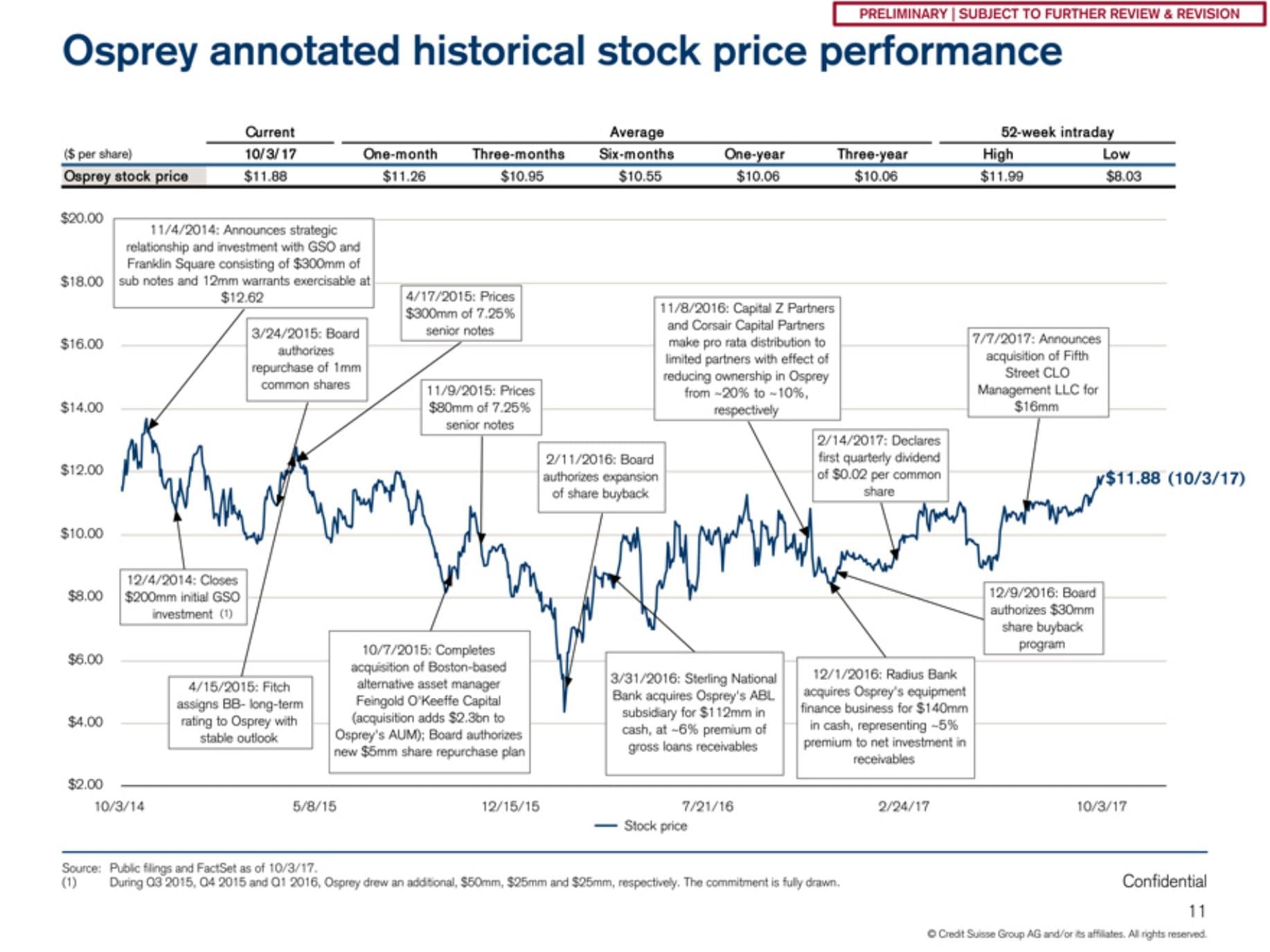
The annotated stock chart is the page that sets up everything else. It plots three years of trading with every material event marked: the 2014 GSO and Franklin Square investment of $300 million in subordinated notes plus 12 million warrants struck at $12.62, the 2015 acquisition of Feingold O'Keeffe, the 2016 sale of the ABL subsidiary to Sterling National, the 2016 equipment finance sale to Radius Bank, and the July 2017 purchase of Fifth Street's CLO management business for $16 million.
Valuing a CVR nobody can predict
Here is the page that makes this deck unusual. Credit Suisse lays out the assumptions it was directed to make, and the first one is remarkable: assume the IRS refunds the taxes paid "without any reduction in amount, delay or condition." That is not a conclusion the bank reached. It is an instruction from management, and the deck says so explicitly.
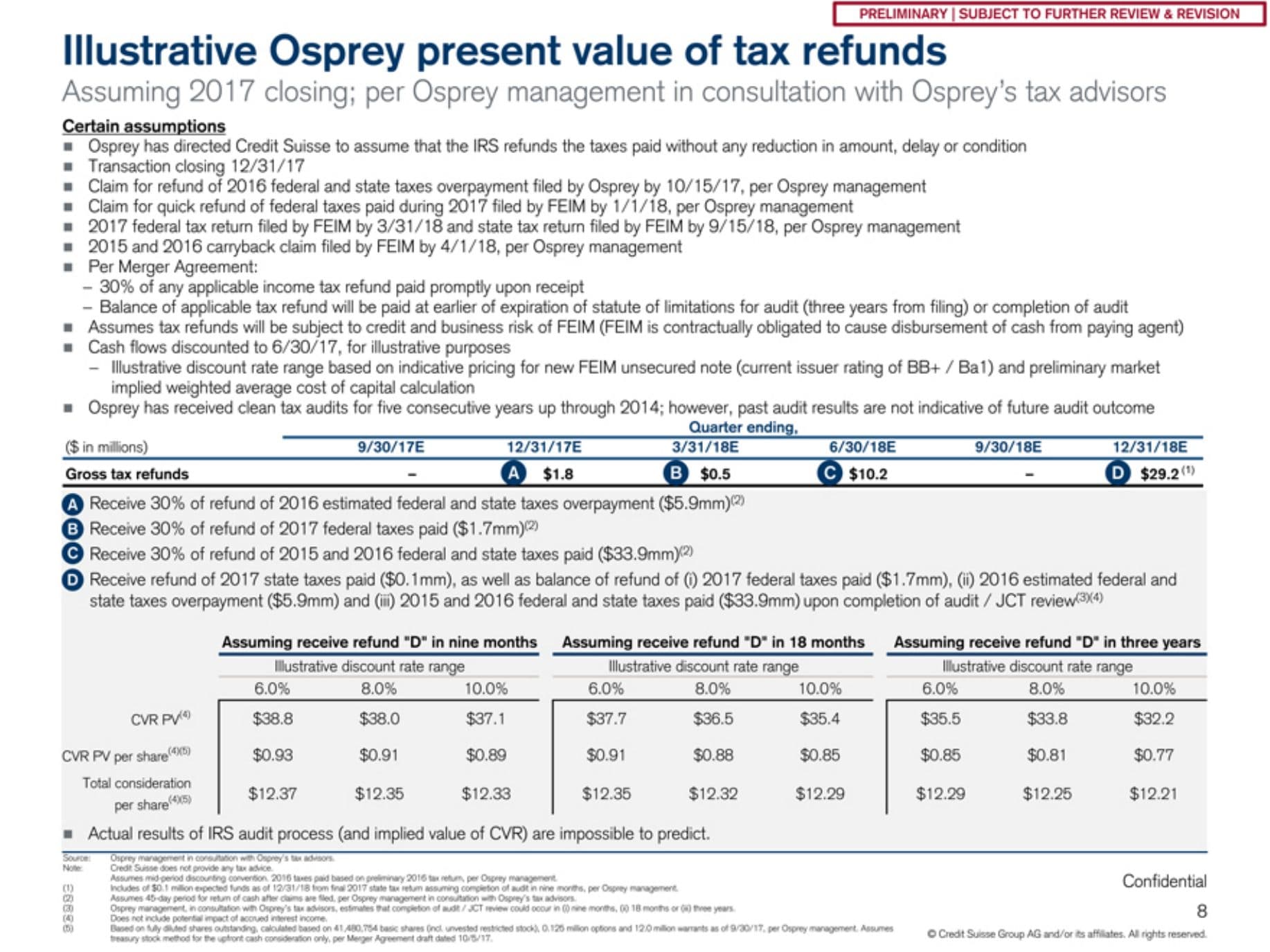
The mechanics matter. Under the merger agreement, 30% of any applicable refund was to be paid to shareholders promptly on receipt. The balance would wait for the earlier of the expiration of the audit statute of limitations, three years from filing, or the completion of the audit. So the CVR is really two instruments stacked: a near-certain, near-term 30% slice, and a much larger tail payment sitting behind a government process with no fixed clock.
Credit Suisse handled that by refusing to give one answer. It ran the value across three timing scenarios and three discount rates, producing a nine-cell grid rather than a point estimate. The spread, $0.77 to $0.93 a share, is only sixteen cents, which is itself the useful finding: even under materially different assumptions the CVR is worth under a dollar, so it was never going to be the thing that made or broke the deal.
The discount rate choice is worth flagging for anyone building something similar. The deck says the range was based on indicative pricing for a new First Eagle unsecured note, with the issuer rated BB+ / Ba1. In other words, the CVR was discounted at the acquirer's credit, not at a risk-free rate, because the shareholder's exposure is to First Eagle's obligation to pass the cash through. That is the correct instinct and a detail people routinely get wrong.
Why the closing date changed the price
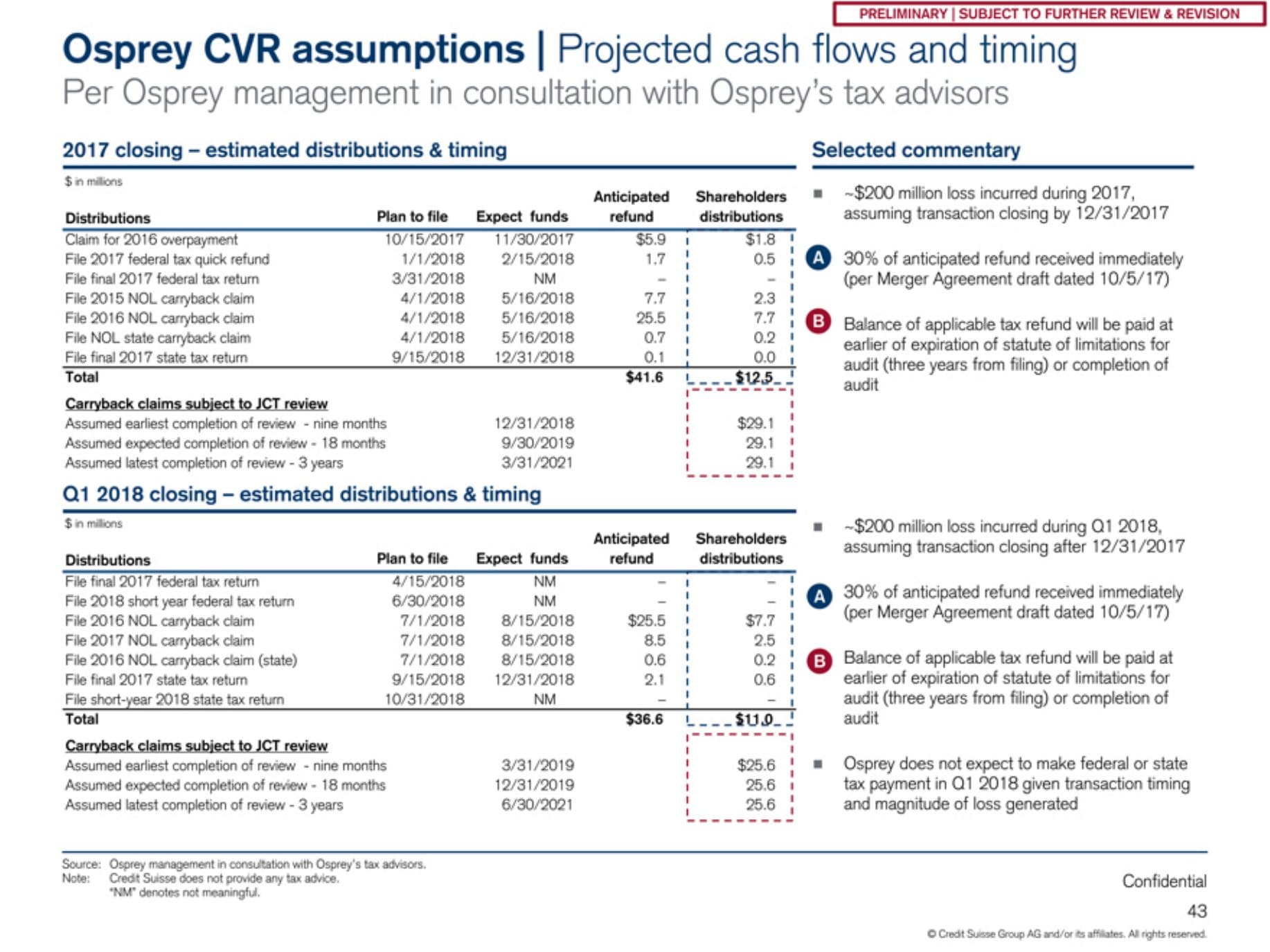
One structural quirk deserves attention because it is the kind of thing that only shows up when you read the real document. The headline consideration is not a single number. It is $12.44 a share assuming a December 31, 2017 close and $12.32 assuming a first quarter 2018 close.
The reason is tax. NewStar expected to generate roughly $200 million of losses in whichever year the transaction closed, and the pattern of refunds and carryback claims shifts depending on which tax year absorbs them. Close in 2017 and the refund calendar runs one way, close in 2018 and it runs another, with total gross refunds falling from $41.6 million to $36.6 million and shareholder distributions falling with them. The deal was, quite literally, worth less if it closed late.
The projections underneath
Every valuation in the deck runs off management's September 2017 plan, and the assumptions page is a good example of what a lender's forecast actually contains, which is not revenue growth so much as spread, credit and funding.
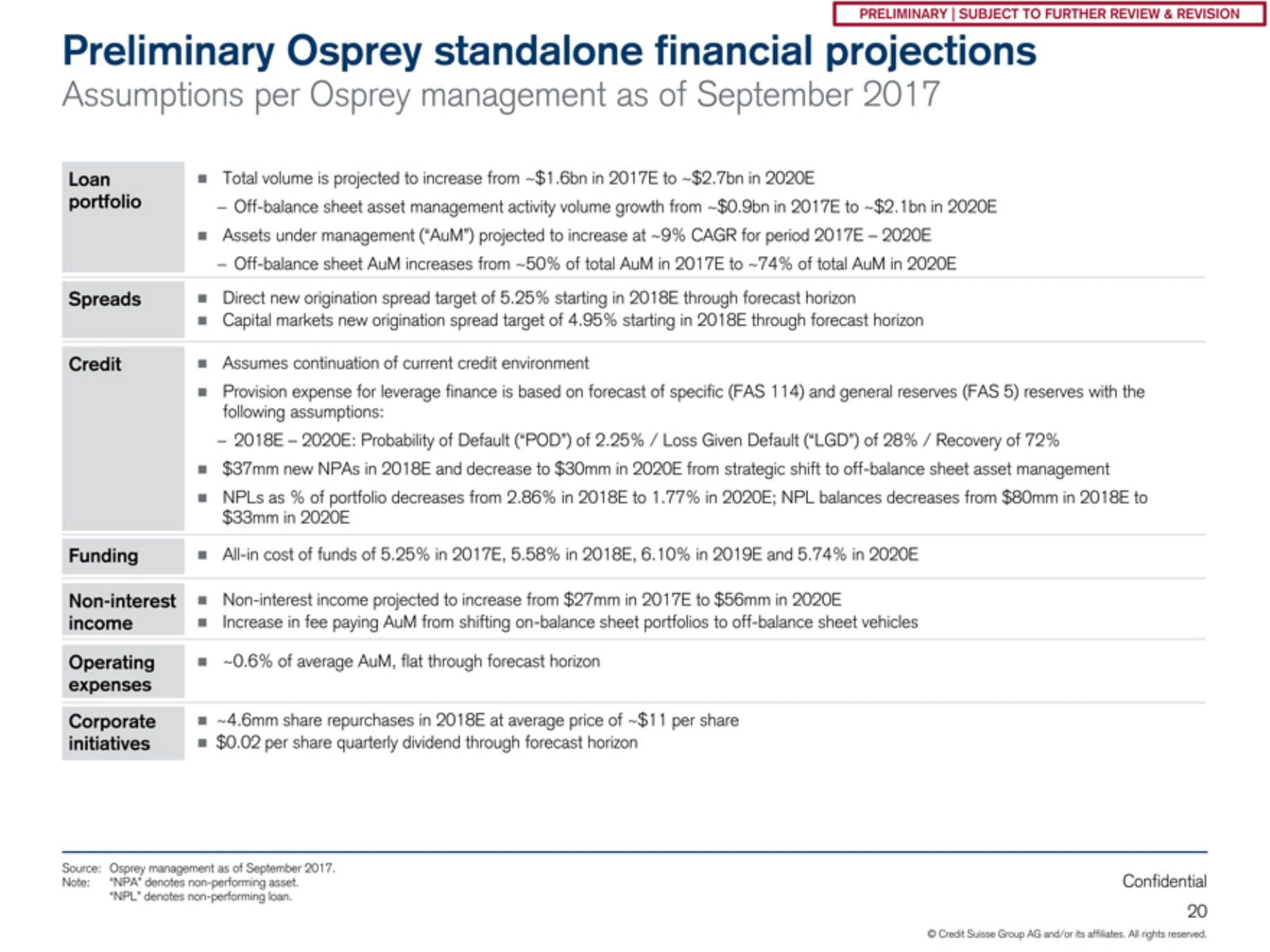
The headline numbers: total volume growing from roughly $1.6 billion in 2017 to $2.7 billion by 2020, assets under management compounding at about 9%, direct origination spreads targeted at 5.25% and capital markets at 4.95%, and credit modeled on a 2.25% probability of default with a 28% loss given default. Cost of funds rises from 5.25% to 5.74% across the window, which quietly squeezes the spread the whole plan depends on.
The most consequential assumption is the shift toward off-balance-sheet asset management. That is a business model change, not a growth rate, and it is what justifies valuing the company on something other than pure book value.
The football field
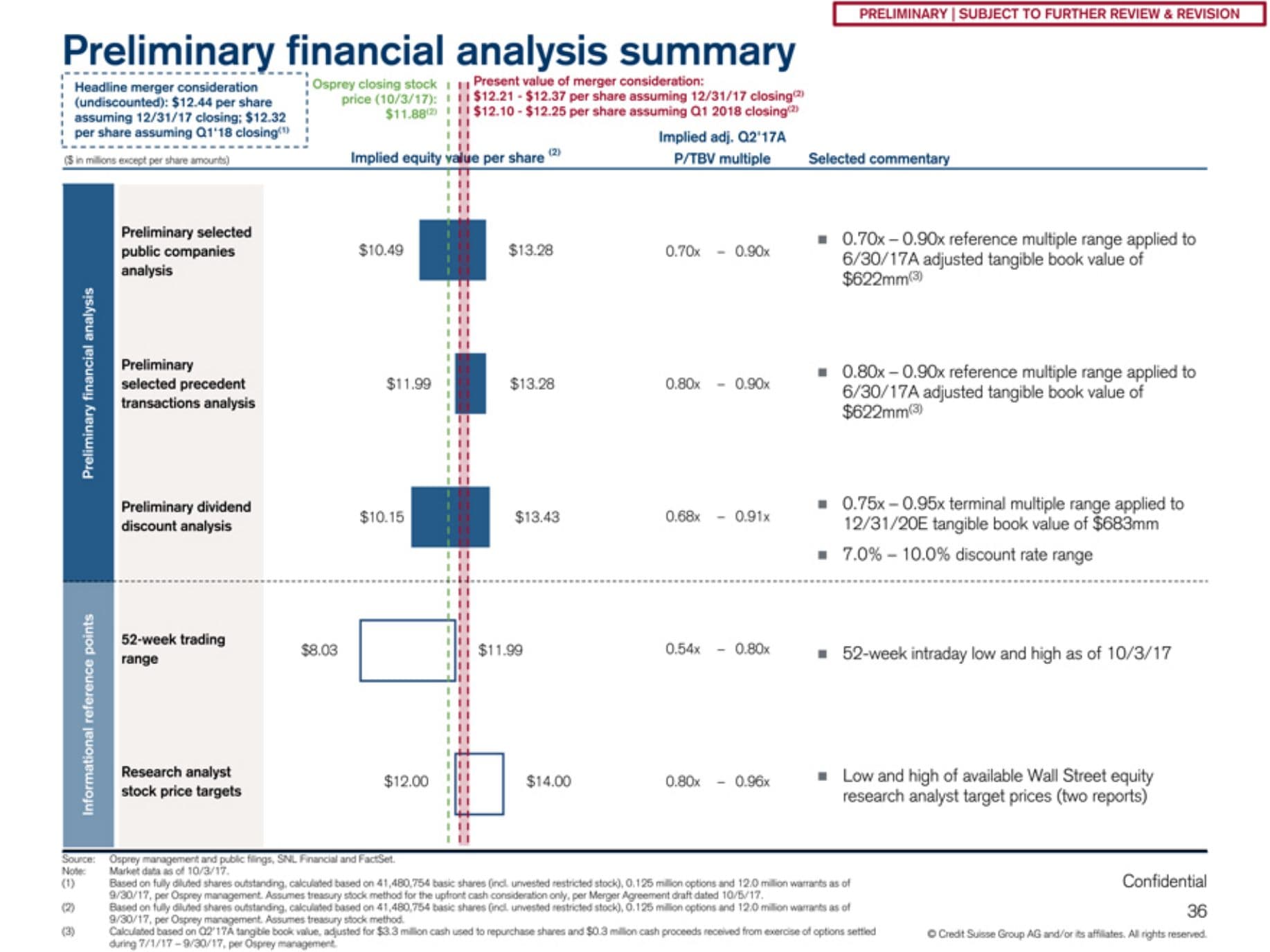
The summary page stacks every methodology against the offer, and it is a tidy illustration of how a banker frames a conclusion without ever saying the price is good.
| Methodology | Implied value per share | Basis |
|---|---|---|
| Selected public companies | $10.49 – $13.28 | 0.70x–0.90x P/TBV on $622M adjusted tangible book |
| Selected precedent transactions | $11.99 – $13.28 | 0.80x–0.90x P/TBV on the same $622M |
| Dividend discount analysis | $10.15 – $13.43 | 0.75x–0.95x terminal on 2020E book of $683M, 7%–10% discount |
| 52-week trading range | $8.03 – $11.99 | Informational only |
| Research analyst targets | $12.00 – $14.00 | Two reports, informational only |
Look at where the consideration falls. At $12.21 to $12.37 it sits comfortably inside the precedent transactions range and inside the public comps range, but below the midpoint of the analyst targets and below the top of every methodology. That is a defensible fairness conclusion rather than a flattering one, which is what you want to see from a bank that is about to put its name on an opinion.
The precedent set is thin and the deck admits it. Only two transactions carry the median, CION and Credit Suisse Park View at 0.94x book and Ares and American Capital at 0.89x, with PennantPark and MCG at 0.99x explicitly excluded from the mean and median. Building a valuation range off a two-deal sample is a real weakness, and disclosing the exclusion is the honest way to handle it.
The premium problem
The premiums paid analysis is the least comfortable page in the deck if you were a NewStar shareholder.
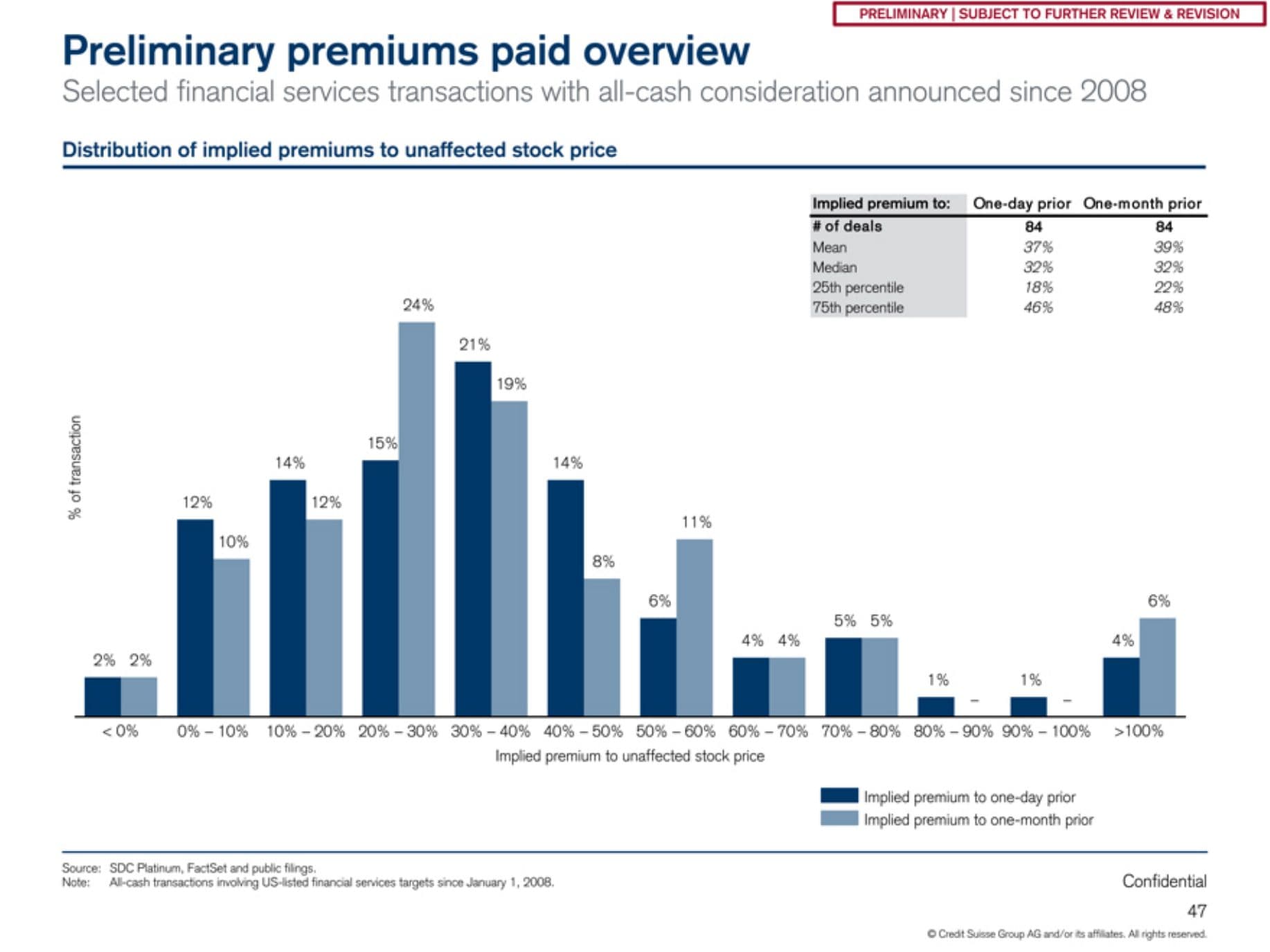
Against an unaffected price of $11.88, total consideration of roughly $12.37 is a premium of about 4%. The reference set on this page has a median one-day premium of 32% and a 25th percentile of 18%. NewStar's deal sits far below even the bottom quartile of comparable transactions.
That gap is the single most important thing in the deck, and notice that the deck presents it plainly rather than burying it. The defense is that NewStar was trading at a premium to its own book value going in and the company had been shrinking through asset sales for two years, so a control premium calculated off an already-elevated price is misleading. Whether you find that persuasive is exactly the judgment a board is paid to make, and the document gives a reader everything needed to disagree with it.
What this teaches
Contingent consideration gets valued as a probability-weighted grid, not a number. When timing is outside everyone's control, the honest output is a range across scenarios, and the useful question is not what the CVR is worth but how much the answer moves across the plausible range. Here it moved sixteen cents, so it was decoration rather than substance.
Discount contingent payments at the payer's credit. Shareholders were relying on First Eagle to pass through cash, so the acquirer's BB+ / Ba1 borrowing cost was the right benchmark, not a government rate, even though the underlying asset was a Treasury refund.
A thin precedent set is a disclosed weakness, not a hidden one. Two transactions carrying a median is fragile, and the correct response is to say so and let the reader weigh it, which is what this deck does.
And a low premium is not automatically a bad deal, but it does demand an explanation. The deck puts the 84-deal distribution on the page knowing the transaction lands well below it. That is what separates a real board document from a pitch.
Every figure and slide in this piece comes from the Credit Suisse presentation filed as Exhibit (c)(1) to NewStar Financial, Inc.'s Schedule 13E-3 (CIK 0001373561), filed November 27, 2017, and available on SEC EDGAR. Slides are reproduced for commentary and criticism with attribution. Projections shown are management's own and were not independently verified by Credit Suisse. This article is for informational purposes only and does not constitute investment, legal, or financial advice.
Keep reading
Want this applied to your situation?
If you're prepping for FIG or M&A technicals, or trying to understand how contingent consideration actually gets valued, a session covers your specific situation.